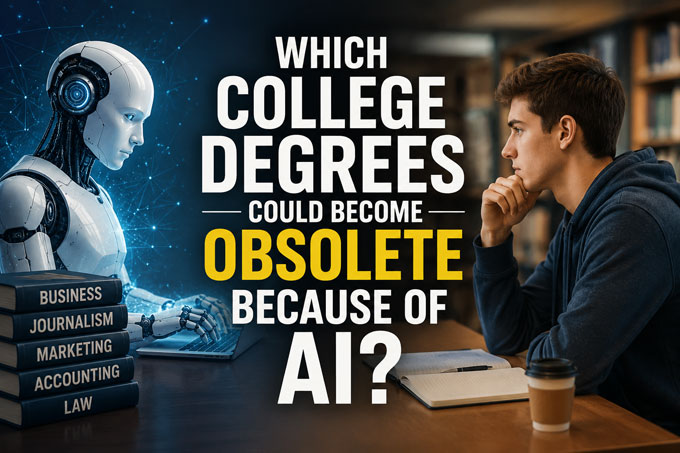
For decades, earning a college degree has been one of the most common pathways to professional success. A degree signaled that a student had acquired specialized knowledge, developed intellectual discipline, and invested years preparing for a career. Employers viewed degrees as evidence that candidates possessed skills that were difficult to obtain elsewhere.
Today, however, the rapid rise of Artificial Intelligence is causing many students, parents, educators, and employers to ask an uncomfortable question: Could certain college degrees become obsolete?
It is a reasonable question. AI is already capable of analyzing information, generating content, conducting research, writing code, summarizing documents, and performing many other tasks that were once considered the exclusive domain of highly educated professionals.
But after spending more than twenty years consulting with businesses, nonprofits, educational institutions, startups, and government-related organizations, I think the conversation is often framed incorrectly. The better question may not be which degrees will disappear. The better question may be which skills employers will continue to value in a world where information becomes increasingly abundant and accessible.
AI is not making knowledge irrelevant. It is making knowledge alone less valuable. The graduates who thrive will be those who combine expertise with judgment, creativity, communication, and adaptability.
The Real Disruption Is Not About Degrees
Throughout history, new technologies have disrupted industries and transformed labor markets. The Industrial Revolution automated physical labor. Computers automated calculations and administrative tasks. The internet transformed how information is created and distributed.
AI represents the next major shift. What makes this disruption unique is that it affects many forms of knowledge work. Tasks that once required years of education and training can increasingly be completed with the assistance of intelligent software. Yet technology rarely eliminates the need for human capability altogether. Instead, it changes which capabilities are most valuable.
The professions that thrive in the coming years may not necessarily be the ones that resist AI. They may be the ones that learn how to combine human judgment with AI-powered efficiency.
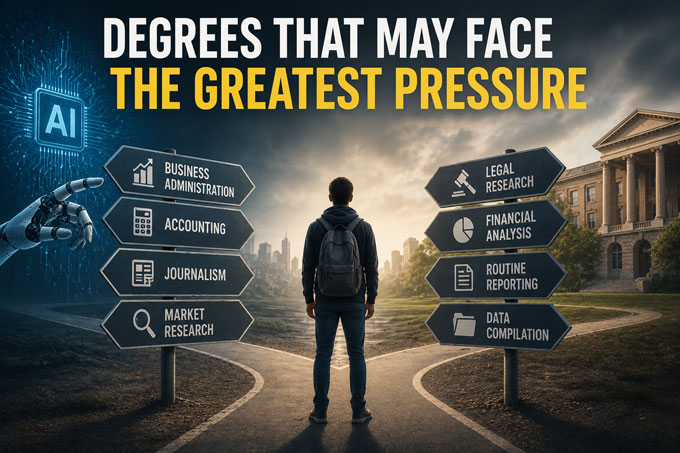
Degrees That May Face the Greatest Pressure
When people ask which degrees might become obsolete, they are often looking for a list of specific majors. I think it is more helpful to think about the characteristics of academic programs that may face increasing pressure. Programs that primarily prepare students for highly structured, repeatable information-processing work could become more vulnerable as AI capabilities continue to improve. This does not mean the degrees themselves become worthless. It means the work graduates perform may change significantly.
Programs that could face pressure include those heavily focused on:
- routine research and information gathering
- standardized reporting and documentation
- basic content creation
- repetitive analytical processes
- formula-driven decision-making
If a large portion of a role consists of collecting information, organizing information, summarizing information, and presenting information, AI will likely become increasingly capable of assisting with those tasks. The challenge for universities is ensuring graduates bring something more to the table than tasks that can be automated.
Why Knowledge Is Becoming Less Scarce
Historically, specialized knowledge created enormous professional value. Lawyers spent years learning legal frameworks. Marketers studied consumer behavior and advertising principles. Financial professionals learned how to analyze markets and interpret data. In many cases, expertise was valuable because access to information was limited.
Today, AI can retrieve, organize, summarize, and explain information in seconds. That changes the economics of knowledge. Knowledge remains important. In fact, expertise may become even more important. But the value increasingly shifts toward people who know how to apply knowledge, evaluate competing ideas, recognize nuance, and make sound decisions in uncertain situations. The future may belong less to information holders and more to information interpreters.
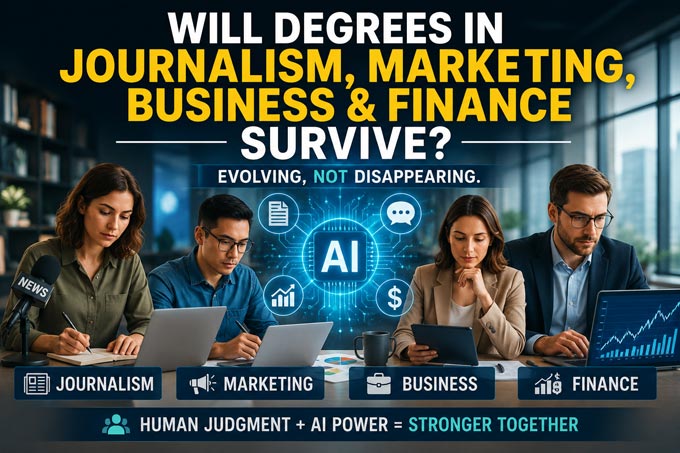
Will Degrees in Journalism, Marketing, Business & Finance Survive?
Absolutely. In fact, many of these fields may remain extremely important. What will likely change is the nature of the work.
Consider marketing. AI can already generate social media posts, blog articles, email campaigns, ad copy, and marketing plans. As someone who has worked in marketing and consulting for many years, I can tell you that creating content was never the hardest part of marketing. Understanding customers is hard. Building trust is hard. Developing a compelling strategy is hard. Making decisions with incomplete information is hard. Those challenges remain remarkably human.
The same principle applies across many professions. Journalists may spend less time producing routine summaries and more time investigating stories. Financial professionals may spend less time building spreadsheets and more time advising clients. Business leaders may spend less time collecting data and more time interpreting what that data means. The work evolves, but the profession remains.
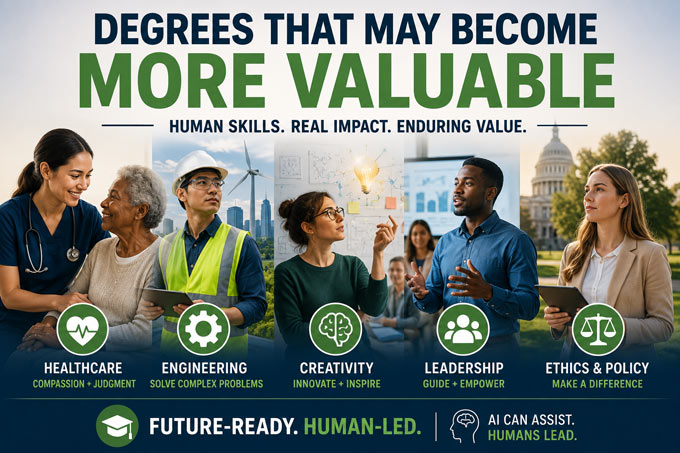
The Degrees That May Become More Valuable
Ironically, AI may increase the value of certain educational experiences. Programs that emphasize human judgment, creativity, leadership, communication, ethics, and interdisciplinary thinking may become even more valuable. These are areas where human beings continue to possess significant advantages.
Examples may include:
- engineering programs that combine technical expertise with systems thinking
- healthcare fields requiring empathy and complex judgment
- leadership and organizational development programs
- technology and public policy programs
- interdisciplinary programs that bridge multiple domains of knowledge
The future economy will likely reward people who can connect ideas across disciplines rather than simply master isolated bodies of information.
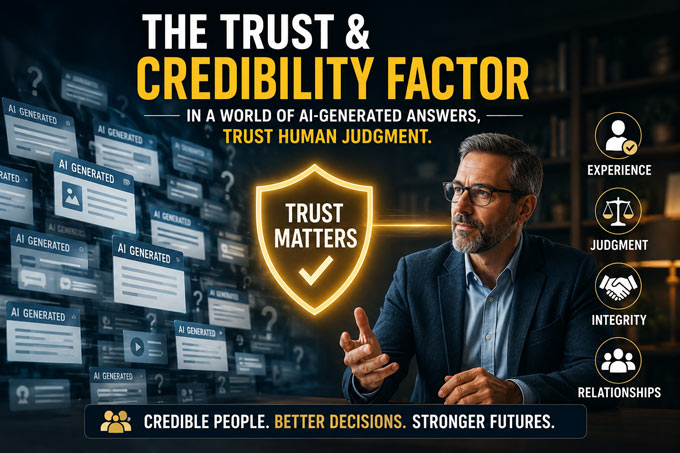
The Trust & Credibility Factor
One aspect of this conversation receives far less attention than it deserves. As AI-generated information becomes increasingly common, trust may become more important, not less. Organizations already face a growing challenge in determining which information is reliable, accurate, and credible.
The same challenge applies to people. In a world filled with AI-generated answers, employers may increasingly value individuals who demonstrate sound judgment, integrity, credibility, and the ability to earn trust. These qualities do not appear on a transcript. Yet they often determine who advances into leadership roles.
Students who focus exclusively on technical knowledge may discover that technical knowledge alone is no longer enough. Students who develop communication skills, leadership abilities, relationship-building capabilities, and professional credibility may find themselves exceptionally well-positioned.
The Strategic Challenge Facing Universities
Universities face an important strategic challenge. They must decide whether they are preparing students for jobs as they exist today or for careers that may evolve dramatically over the next decade.
That requires asking difficult questions:
- Are students being trained to perform tasks that AI can increasingly automate?
- Are graduates learning how to work effectively alongside AI?
- Are academic programs emphasizing durable human capabilities?
- Are students being prepared to adapt as technology continues to evolve?
The institutions that answer these questions effectively may become leaders in the next era of higher education. Those that continue relying on educational models designed for a pre-AI world may face increasing pressure.

What I’ve Learned After 20 Years of Consulting
Over the past twenty years, I have had the opportunity to work with organizations across a wide range of industries. One lesson appears again and again. The people who create the most value are rarely the people who simply possess the most information. They are the people who can solve problems. They are the people who can navigate uncertainty. They are the people who can communicate effectively, earn trust, connect ideas across disciplines, and make sound decisions when there is no obvious answer. Those are precisely the kinds of capabilities that become more valuable when information itself becomes abundant.
That is why I am skeptical whenever I see headlines claiming that AI will make entire categories of college degrees obsolete. I think something more nuanced is happening. AI is changing which parts of professional work create value. Routine knowledge work is becoming easier to automate. Human judgment is becoming more important.
The future belongs not to people who compete against AI, but to people who learn how to think, lead, create, communicate, and exercise judgment alongside it. The universities that understand this shift may continue producing highly sought-after graduates for decades to come. The ones that do not may eventually discover that the real challenge was never AI itself. The real challenge was preparing students for a future that was already beginning to arrive.





Comment Policy: To help prevent spam and keep discussions readable, submitted comments may not include HTML or links.