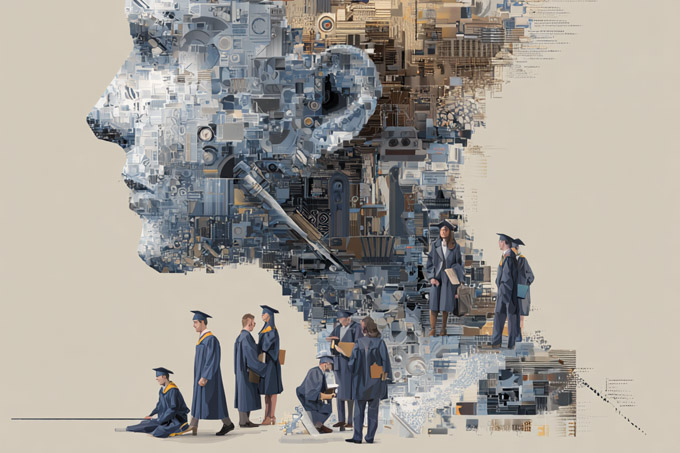
For decades, higher education has served as the primary gateway to professional opportunity. College and university degrees have traditionally represented a combination of specialized knowledge, critical thinking, and credentials that signal readiness for a complex workforce.
Today, however, the rise of Artificial Intelligence is reshaping the labor market in ways that few higher education institutions have fully anticipated. From automating routine tasks to generating insights once reserved for trained specialists, AI is changing what skills are valuable – and which careers may thrive in the coming decades.
This raises a fundamental question: Is higher education preparing students for an AI-driven economy, or are universities and colleges falling behind?
The AI Economy: Redefining Work & Skills
Artificial intelligence is no longer a distant promise – it is actively reshaping industries. AI systems can analyze massive datasets, draft written content, conduct research, generate strategic insights, and even perform tasks that previously required highly trained professionals.
In this environment, the skills that once guaranteed employability – rote analysis, repetitive problem-solving, and even certain technical knowledge – may no longer hold the same value. Students entering the workforce with degrees in fields where tasks are increasingly automated may find themselves underprepared for the realities of an AI-enabled economy.
The AI economy rewards skills that AI cannot easily replicate, including:
- strategic and systems thinking
- creativity and innovation
- ethical judgment and decision-making
- human leadership and interpersonal collaboration
- the ability to synthesize insights from AI into actionable plans
Universities must ask whether their curricula are emphasizing these capabilities – or whether they are still primarily teaching students tasks AI can perform faster and at scale.
Where Higher Education Excels
Despite the rapid changes brought by AI, higher education still provides essential skills that remain highly relevant:
Critical thinking & analytical reasoning: Many programs teach students how to approach problems systematically, evaluate evidence, and construct arguments – abilities that remain essential even when AI performs data analysis.
Interdisciplinary learning: Universities often encourage students to integrate insights across multiple fields, fostering creativity and innovation.
Ethical & social awareness: Degrees in philosophy, social sciences, and humanities provide context for understanding the societal impacts of technology, including AI ethics, privacy, and fairness.
These aspects of education are more important than ever. AI may handle analysis and repetitive tasks, but it cannot replace human judgment, creativity, or ethical reasoning. Students equipped with these skills may find themselves better positioned to leverage AI tools effectively.
Where Higher Education Falls Short
Despite these strengths, several gaps suggest universities may not yet be fully preparing students for an AI-driven workforce:
Limited AI literacy: Many students graduate with little understanding of AI’s capabilities, limitations, or practical applications. Few programs teach students how to evaluate, implement, or collaborate with AI systems in professional contexts.
Overemphasis on rote skills: Degrees that focus on procedural knowledge – basic accounting, certain types of data analysis, or repetitive research tasks – may become less valuable as AI automates those functions.
Slow adaptation of curricula: Universities often update courses and degree requirements slowly, creating a lag between industry needs and the skills students graduate with. By the time curricula reflect AI-driven changes, graduates may already face a skills gap.
Insufficient focus on human-AI collaboration: Preparing students for an AI economy requires teaching them how to work alongside intelligent machines, not just performing tasks independently. Many programs still emphasize individual achievement over collaborative problem-solving in tech-enabled environments.
Degrees Most Vulnerable to AI Disruption
Certain fields may face significant disruption if programs fail to adapt:
- Basic business administration: Routine reporting, financial modeling, and market analysis can increasingly be performed by AI systems.
- Journalism & communications: AI can generate drafts, summaries, and content, shifting the value toward investigative, creative, and editorial skills.
- Accounting & finance: Standardized analysis and auditing tasks are increasingly automated.
- Some areas of research-heavy fields: Preliminary research and literature reviews can be accelerated by AI tools.
These changes do not make the degrees irrelevant, but they require a redesign of curricula to focus on higher-order thinking, human judgment, and AI-assisted innovation.
Degrees That Will Thrive
Some fields are likely to become even more valuable in an AI economy, particularly those that emphasize human-centered, complex problem-solving:
- Engineering and technology programs that teach AI development and integration
- Healthcare and medical programs where human decision-making, empathy, and judgment are critical
- Interdisciplinary programs combining technical knowledge with business, ethics, or social sciences
- Leadership, management, and organizational studies that teach strategic thinking and change management
These degrees prepare students not only to use AI tools but also to shape how AI is applied in organizations, making them indispensable in future workplaces.
The Role of Universities in Bridging the Gap
To remain relevant in an AI-driven economy, universities must rethink both curriculum and pedagogy:
Integrate AI literacy across disciplines: Students should understand the basics of AI, machine learning, and data ethics regardless of their major.
Emphasize human-AI collaboration: Teach students to use AI as a partner in problem-solving rather than a replacement for human effort.
Focus on creativity, ethics & strategic judgment: Courses should cultivate uniquely human capabilities that AI cannot replicate.
Foster experiential learning & adaptability: Real-world projects, simulations, and interdisciplinary problem-solving exercises help students develop practical skills that remain valuable in a rapidly changing economy.
Universities that proactively embrace these changes will produce graduates who are not just employable, but capable of leading in AI-enhanced workplaces.
My 2 Cents: Preparing Students for the AI-Driven Workforce
The AI economy is reshaping the skills required to succeed, and higher education must respond. Students who graduate with an understanding of AI’s capabilities, ethical implications, and collaborative potential will be better positioned to thrive.
Those universities that continue to focus solely on traditional knowledge acquisition risk producing graduates whose skills are partially redundant in an AI-enhanced world.
The central challenge for higher education is clear: Prepare students not just to compete in today’s economy, but to lead in an AI-driven future.
Institutions that meet this challenge will not only remain relevant – they will become critical partners in shaping the next generation of professionals who can thrive alongside intelligent machines.





Comment Policy: To help prevent spam and keep discussions readable, submitted comments may not include HTML or links.