
Nonprofit boards are designed to safeguard mission, steward resources, and provide collective oversight. The chair of the board is entrusted with facilitating that work – not dominating it. But what happens when the board chair becomes a narcissistic, authoritarian presence? When disagreement is punished. When dissent is mocked or belittled. When loyalty is rewarded and independent thinking is persecuted. When the board feels less like a governing body and more like an audience.
This situation is more common than many realize. And it is deeply destabilizing. When a board chair behaves as a dictator – demanding control, silencing opposition, and personalizing governance – the issue is no longer interpersonal. It is structural. It is strategic. And it threatens the integrity of the organization itself.
The question is not simply “How do we manage a difficult personality?” The real question is: How does a board reclaim its governance authority when control has been informally captured by one individual?
Governance breaks down when disagreement becomes dangerous and silence becomes the norm. Strong boards protect the mission by fostering accountability, encouraging diverse perspectives, and ensuring that authority remains collective rather than personal.

Recognizing What Is Actually Happening
Boards often minimize the problem at first. Members may say: “He’s just strong-willed.” “She’s passionate.” “It’s easier not to push back.” “We don’t want conflict.” But narcissistic board leadership follows a predictable pattern:
- Public praise for compliant members
- Private or public humiliation of dissenters
- Control of agendas and discussion flow
- Strategic isolation of critics
- Personalization of disagreement
- Equating disagreement with disloyalty
Over time, intelligent, capable board members go quiet. Meetings become scripted. Votes become ceremonial. Governance becomes performative. And the most dangerous development occurs: the board begins to feel helpless. That sense of helplessness is precisely what allows authoritarian behavior to consolidate power.
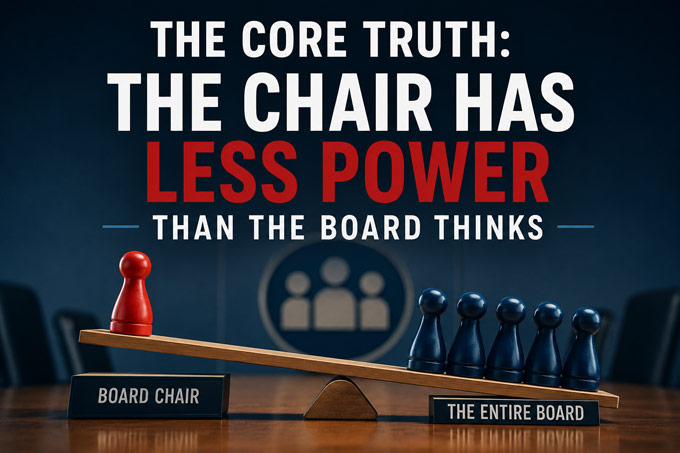
The Core Truth: The Chair Has Less Power Than the Board Thinks
A board chair has influence – but not unilateral authority. The legal authority rests with the full board collectively. The chair cannot override bylaws, unilaterally control votes, silence members legally, remove directors without process, or own the organization. When a board feels that control has been “stolen,” it is usually because members have ceded authority informally – not because they have lost it legally. That distinction matters. The issue is rarely lack of power. It is lack of coordinated action.
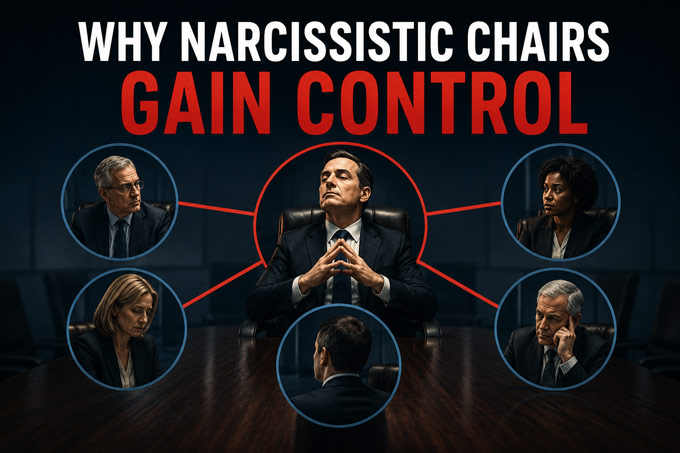
Why Narcissistic Chairs Gain Control
Understanding the dynamics helps boards respond effectively.
1. Divide-and-Conquer Tactics
Narcissistic leaders often build one-on-one loyalty while isolating critics. Board members feel alone in their concerns.
2. Fear of Retaliation
Members who speak up are belittled, sidelined, or attacked. Others observe and stay silent.
3. Social Politeness
Many board members are accomplished professionals unused to personal attacks. They default to civility while the chair exploits it.
4. Misunderstanding of Governance
Some boards mistakenly believe the chair is “in charge” in a CEO-like way. In nonprofit governance, that is not the structure. Silence becomes interpreted as consent. Consent becomes perceived as legitimacy.
The Cost of Doing Nothing
When a narcissistic chair dominates unchecked, the organization suffers:
- Strategic decisions reflect ego rather than mission
- Executive leadership becomes intimidated or compliant
- Board recruitment shifts toward loyalty over competence
- Donor relationships may become personality-based rather than mission-based
- Reputational risk increases
- Long-term governance culture erodes
Eventually, capable board members resign. What remains is a hand-selected group of compliant voices. At that point, recovery becomes significantly harder.

What the Board Should Do
This situation requires courage – but it also requires strategy. Emotional confrontation rarely works. Structural action does.
1. Quietly Assess Alignment
Most authoritarian chairs rely on the assumption that dissenters are isolated. They often are not. Board members should have private conversations with one another – not to gossip, but to assess shared concerns. You may discover that multiple members feel the same frustration, several have considered resigning, and many assumed they were alone. Isolation is the narcissist’s advantage. Alignment dissolves it.
2. Return to the Bylaws
Governance reform begins with documents, not emotion. Review removal procedures for officers, term limits, vote thresholds, processes for calling special meetings, and executive session rules. Most boards are far more empowered on paper than they realize. Governance authority is structural, not personality-based.
3. Reclaim the Agenda
Control of meeting agendas is control of narrative. Boards can vote to approve agendas collectively, request structured time for open discussion, add governance review as a formal agenda item, and call executive sessions without the chair present (if permitted by bylaws). Transparency reduces manipulation.
4. Shift From Personal Critique to Governance Framing
Direct attacks on a narcissistic chair’s personality will escalate conflict.
Instead, reframe concerns in governance language:
- “Our bylaws require collective oversight.”
- “Healthy governance includes dissent.”
- “Board culture should allow respectful disagreement.”
- “Strategic decisions require full participation.”
Make the issue structural – not personal. This reduces emotional defensiveness and strengthens legitimacy.
5. Use Executive Session Strategically
If allowed, boards should meet without the chair to discuss governance concerns. This allows honest dialogue, assessment of risk, exploration of options, and development of unified next steps. Authoritarian control thrives in public dominance. It weakens in structured private coordination.
6. Consider Leadership Rotation or Removal
If behavior does not change, the board must consider formal action. Options may include electing a new chair at the next term, voting for removal under bylaw provisions, creating shared leadership structures, and/or limiting unilateral authority. This is not insubordination. It is governance. A board unwilling to remove a destructive chair must accept responsibility for the resulting dysfunction.
7. Protect the Executive Director
In many cases, the executive director is also under pressure. Boards should clarify reporting structure; ensure performance evaluations are conducted collectively; prevent one-on-one intimidation dynamics; and reinforce that the ED answers to the full board, not the chair alone. When chairs dominate executives, mission drift accelerates.
What If the Board Feels Completely Helpless?
If the chair has stacked the board with loyalists and dissenters are a small minority, the path becomes more difficult. At that point, options include recruiting independent new members strategically, engaging outside governance counsel, encouraging donor awareness if governance failure threatens mission, and resigning collectively and documenting concerns. Resignation should not be impulsive – but in extreme cases, it may be the only ethical option if governance cannot be restored. Remaining silently complicit in dysfunction is not neutral. It is participation.
The Psychological Reality
It is important to name something directly: Narcissistic leaders reward loyalty and punish independence. That pattern is intentional. It conditions behavior. Board members may feel anxiety, dread before meetings, or self-doubt. These are common responses to authoritarian leadership. But governance is not about emotional comfort. It is about fiduciary duty. Silence protects the chair. Courage protects the mission.

Reclaiming Governance Culture
Healthy boards normalize disagreement. They encourage challenge, separate ideas from identity, focus on mission over ego, rotate leadership, invite diverse expertise, and protect minority voices. If a chair cannot tolerate dissent, they are unfit for governance leadership. Not because they are imperfect – but because governance requires pluralism.
The Final Question
Every board facing this situation must answer one uncomfortable question: Are we protecting the mission – or protecting our comfort? Authoritarian board chairs remain in power only when others decide conflict avoidance is preferable to confrontation. But nonprofit governance is not a popularity contest. It is a fiduciary responsibility.
If a board truly believes control has been hijacked, then the board must act collectively, deliberately, and structurally to reclaim it. The organization does not belong to the chair. It belongs to the mission. And the board’s duty is to ensure that no individual – no matter how charismatic, wealthy, or forceful – becomes more important than the cause the organization exists to serve.





Comment Policy: To help prevent spam and keep discussions readable, submitted comments may not include HTML or links.