
Many organizations believe they compete primarily on price, products, services, technology, or marketing. In reality, they often compete on something much more fundamental: customer experience.
Over the years, I have worked with organizations across a variety of industries. One pattern appears repeatedly. Companies frequently invest significant resources into attracting customers, yet devote far less attention to what happens after those customers arrive. The result is often predictable.
Marketing may generate interest. Advertising may generate leads. Sales efforts may generate transactions. But customer experience determines whether customers stay. That is why customer experience strategy has become one of the most important – and frequently overlooked – components of long-term organizational success.
In a marketplace where products can be copied and prices can be matched, customer experience remains one of the most powerful and sustainable sources of competitive advantage.
What Is Customer Experience Strategy?
Customer experience strategy (often called CX strategy) is the deliberate effort to create consistent, positive experiences throughout the entire customer journey. Every interaction influences perception.
This includes:
- visiting a website
- calling the organization
- meeting with employees
- receiving products or services
- resolving problems
- receiving follow-up communication
Customers rarely evaluate organizations based on a single interaction. Instead, they form impressions based on the cumulative effect of many experiences over time. A customer experience strategy helps ensure those experiences reinforce trust, confidence, and loyalty rather than frustration or confusion.
Why Customer Experience Matters More Than Ever
Today’s customers have more choices than ever before. They can compare prices instantly. They can read reviews within seconds. They can switch providers with minimal effort. As a result, many products and services have become increasingly difficult to differentiate.
When offerings appear similar, customer experience often becomes the deciding factor. Organizations that consistently make life easier for customers frequently outperform competitors that focus exclusively on pricing, advertising, or product features.
Customers remember how organizations make them feel. They remember whether communication was clear. They remember whether problems were resolved quickly. They remember whether employees seemed genuinely interested in helping. Those experiences shape loyalty far more than many organizations realize.
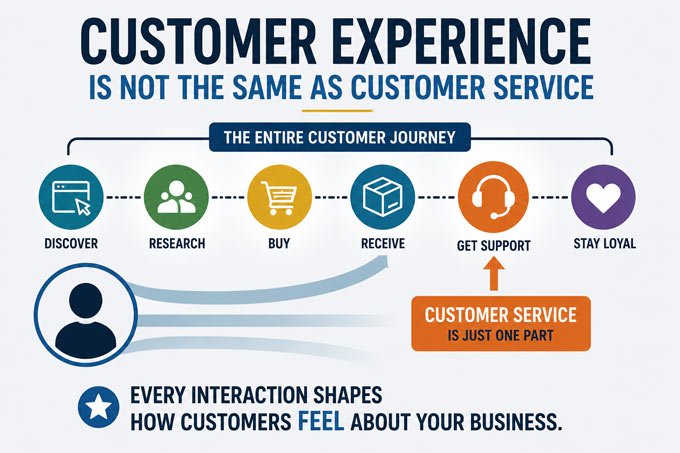
Customer Experience Is Not the Same as Customer Service
One common misconception is that customer experience and customer service are identical. They are not. Customer service is one component of customer experience. Customer experience encompasses the entire relationship.
A customer may receive excellent service from an individual employee while still having a frustrating overall experience because of confusing processes, poor communication, long wait times, or inconsistent follow-up. Likewise, a well-designed customer experience often prevents service issues from occurring in the first place.
Organizations that understand this distinction tend to focus less on isolated interactions and more on the overall customer journey.
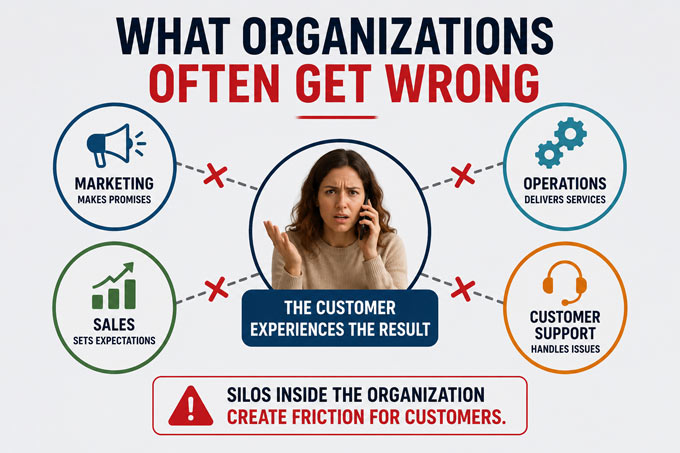
What Organizations Often Get Wrong
Many organizations unintentionally create customer experience problems because different departments operate independently. Marketing makes promises. Sales sets expectations. Operations delivers services. Customer support handles issues. Yet these functions are often disconnected.
Customers do not experience departments. They experience the organization as a whole. When communication breaks down internally, customers feel the consequences externally. Strong customer experience strategies align departments around a common understanding of what customers need and how those needs should be met.
The Role of Employees in Customer Experience
Customer experience is ultimately delivered by people. Even the best-designed systems depend upon employees who communicate effectively, solve problems, and represent the organization well. This is one reason employee experience and customer experience are often closely connected.
Organizations with high turnover, poor morale, inadequate training, or weak leadership frequently struggle to deliver consistent customer experiences. Meanwhile, organizations that invest in employees often find that customer satisfaction improves naturally. Employees who feel valued are generally better equipped to help customers feel valued as well.

Customer Experience Is a Competitive Advantage
Many business leaders view customer experience as a customer service initiative. The most successful organizations view it as a strategic advantage. Strong customer experiences can lead to higher customer retention, stronger reputation, increased referrals, greater customer lifetime value, improved trust, and reduced price sensitivity.
Customers who trust an organization are often less likely to leave over minor issues, small price differences, or competitive offers. That trust becomes a valuable business asset.
What This Means for Organizations
Customer experience strategy is not about creating occasional moments of delight. It is about consistently reducing friction, solving problems, communicating clearly, and making it easier for customers to achieve their goals. Organizations that treat customer experience as a strategic priority often build stronger relationships, stronger reputations, and stronger long-term performance.
In a marketplace where products can be copied, prices can be matched, and marketing messages can be imitated, customer experience remains one of the few competitive advantages that is difficult to replicate. The organizations that understand this are often the ones customers remember, trust, and continue choosing year after year.





Comment Policy: To help prevent spam and keep discussions readable, submitted comments may not include HTML or links.