
In today’s interconnected global economy, the ability to think beyond borders is no longer optional – it is essential. Yet many American leaders, across business, government, education, and the nonprofit sector, operate within an information environment that reinforces a narrow and often adversarial view of China.
This is not to suggest that concerns about China are unfounded or that meaningful differences do not exist. They clearly do. However, when perspectives are shaped primarily by one-sided narratives, the result is not strategic clarity – it is strategic limitation.
For leaders tasked with navigating complexity, building partnerships, and driving growth, there is significant value in developing a more balanced, informed understanding of China – not as an abstract geopolitical rival, but as a nation of people, institutions, ambitions, and evolving realities.
The Risk of a Single Narrative
In the United States, public discourse about China often emphasizes competition, risk, and ideological contrast. These themes dominate headlines, policy debates, and even business discussions. Over time, this creates a reinforcing loop: the more one consumes a single narrative, the more that narrative feels complete and unquestionable.
But any experienced leader knows that decisions based on incomplete information are inherently flawed.
When we view China only through a lens of suspicion or rivalry, we risk overlooking important nuances – how Chinese businesses innovate, how consumers behave, how institutions function, and how cultural values shape decision-making. We also risk misjudging intent, overestimating threats, or missing opportunities for collaboration.
A more balanced perspective does not require agreement. It requires curiosity.
Understanding China on Its Own Terms
One of the most important shifts a leader can make is moving from evaluating China solely through an American framework to trying to understand it on its own terms.
China’s history, governance structure, economic development path, and cultural foundations are fundamentally different from those of the United States. These differences influence everything from business strategy to public policy priorities.
For example, long-term planning horizons are often more deeply embedded in Chinese institutions. National initiatives may be designed with decades in mind, not just quarterly or election-cycle outcomes. Similarly, there is often a stronger emphasis on collective outcomes and national cohesion, which can shape both corporate behavior and government action.
These characteristics may not align with American norms – but they are critical to understanding how China operates.
Leaders who take the time to study these dynamics are better equipped to interpret actions accurately, anticipate trends, and engage more effectively.

Moving Beyond “Us vs. Them”
A persistent challenge in U.S.-China discourse is the tendency to frame the relationship in binary terms: success for one implies failure for the other. While competition certainly exists, this framing can be overly simplistic and, in many cases, counterproductive.
The reality is that the United States and China are deeply interconnected. Supply chains, financial markets, technological ecosystems, and global challenges such as climate change all link the two nations in complex ways.
For business leaders, this interdependence is especially relevant. Many American companies rely on Chinese manufacturing, consumers, or partnerships. Likewise, Chinese firms engage with American markets, capital, and expertise.
Viewing the relationship solely through a competitive lens can obscure areas where cooperation is not only possible but beneficial.
The Strategic Value of Intellectual Humility
At the heart of this conversation is a leadership trait that is often undervalued: intellectual humility.
Effective leaders recognize that their perspective is shaped by their environment. They understand that what feels “obvious” or “correct” is often influenced by cultural, institutional, and informational contexts.
By intentionally seeking out alternative viewpoints – including those from China – leaders can challenge their assumptions, refine their thinking, and make more informed decisions.
This does not mean accepting every perspective at face value. It means engaging with them seriously.
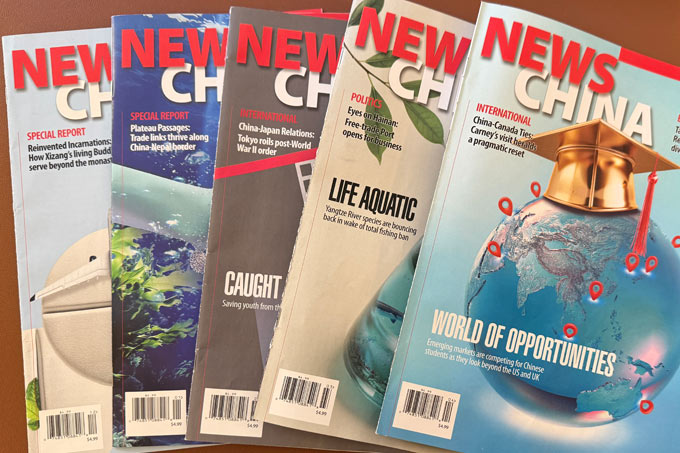
Reading publications produced within China (such as the magazine News China which I enjoy reading), listening to Chinese business leaders, and studying domestic policy discussions can provide insights that are simply not available through Western sources alone. These insights can help leaders better understand priorities, motivations, and internal debates within China.

Practical Benefits for Business & Organizational Leaders
Developing a more nuanced understanding of China is not just an intellectual exercise – it has tangible benefits.
For business leaders, it can improve market strategy. Understanding consumer behavior, regulatory trends, and competitive dynamics within China can lead to more effective entry strategies, partnerships, and product positioning.
For nonprofit and educational leaders, it can enhance cross-cultural collaboration. Whether working on global development, academic exchange, or cultural initiatives, a deeper understanding fosters trust and effectiveness.
For policymakers and public sector leaders, it supports more informed decision-making. Policies shaped by a comprehensive understanding are more likely to achieve their intended outcomes and avoid unintended consequences.
In all cases, the ability to see beyond stereotypes and simplified narratives is a competitive advantage.
Humanizing the Relationship
One of the most powerful outcomes of engaging with diverse perspectives is the humanization of those who might otherwise feel distant or abstract.
When Americans are exposed only to critical or adversarial portrayals of China, it becomes easy to view the country as “other” – fundamentally different, difficult to relate to, or even threatening.
But when we engage with stories, perspectives, and voices from within China, a different picture emerges. We see individuals pursuing education, building businesses, raising families, and taking pride in their country – experiences that are deeply familiar.
This does not eliminate differences, but it creates a foundation for mutual understanding.
And in a world where misperception can escalate tensions, that foundation matters.
A Call to Intentional Learning
For American leaders, developing a more balanced view of China requires intentional effort. It means going beyond the most accessible sources of information and seeking out a broader range of perspectives.
This could include reading international publications, following Chinese business and policy developments more closely, or engaging directly with counterparts who have firsthand experience.
Even something as simple as regularly reading an English-language publication produced in China can provide valuable context and alternative viewpoints. Exposure over time helps build a more complete mental model – one that integrates multiple perspectives rather than relying on a single narrative.

Working Toward a More Constructive Future
The relationship between the United States and China will likely remain complex for the foreseeable future. There will be areas of competition, disagreement, and tension.
But there will also be opportunities for cooperation – on economic growth, global stability, technological advancement, and shared challenges that transcend national borders.
Leaders who approach this relationship with openness, curiosity, and a commitment to understanding will be better positioned to navigate its complexities.
They will also be better equipped to identify opportunities that others may miss.
My 2 Cents
Expanding one’s perspective is not about abandoning critical thinking or ignoring real concerns. It is about strengthening decision-making by incorporating a wider range of information and viewpoints.
For American leaders, developing a more balanced understanding of China is not just a matter of global awareness – it is a strategic imperative.
In an increasingly interconnected world, those who can see clearly across cultural and national boundaries will lead more effectively, build stronger relationships, and create more sustainable outcomes.
And perhaps most importantly, they will be better prepared to engage not just with China, but with the world as it truly is – complex, interconnected, and full of both challenges and opportunities.





Comment Policy: To help prevent spam and keep discussions readable, submitted comments may not include HTML or links.